AN EXPERIMENT IN CONTINUITY
SYNAFLY
Life is a signal.
Keep it going.
Explore a neural world. Stimulate it, capture its state, and let the signal continue.
Enter the experimentThe visual renderer is unavailable. Research and whitepapers remain accessible below.
A moment worth preserving.
PARTICIPATION → POSSIBILITY
Give the next
experiment a future.
A proposed path from token participation to research funding, compute, and reproducible experiments.
PROPOSED MECHANISM · INTERACTIVE PREVIEWParticipate
Token purchases are the intended entry point.
Resource the research
A disclosed allocation would support the research treasury.
Run. Test. Publish.
More compute. More experiments. Results anyone can inspect.
The allocation, treasury, and purchase integration are not live. This preview does not execute a trade or represent actual research progress.
About this simulation +
This is a simplified leaky integrate-and-fire model with 384 neurons, procedural connections, and fly-inspired spatial geometry. Stimuli change membrane potentials and trigger spikes; the traces and telemetry derive from the same model state. Capture and restore apply only to this page session. No measured MICrONS or MaleCNS connectome is loaded. This is not recorded EEG or evidence of consciousness or immortality.
The question of continuity
Life is a process.
Can we preserve its next moment?
A connectome describes how neurons are connected. A simulation lets a model evolve. Our question begins with what happens next: can its changing state be preserved, recovered and carried forward?
One evolving state.
A traceable history.
The possibility to continue.
We use “digital immortality” to describe the capacity to preserve and resume a computational life. Its continuation still depends on storage, compute and maintenance.
The map came
from the scientists.
The scientific foundation is the MaleCNS connectome, a collaborative project led by HHMI Janelia, with Google Research and Cambridge / MRC LMB. It maps the male fruit fly’s brain and ventral nerve cord.
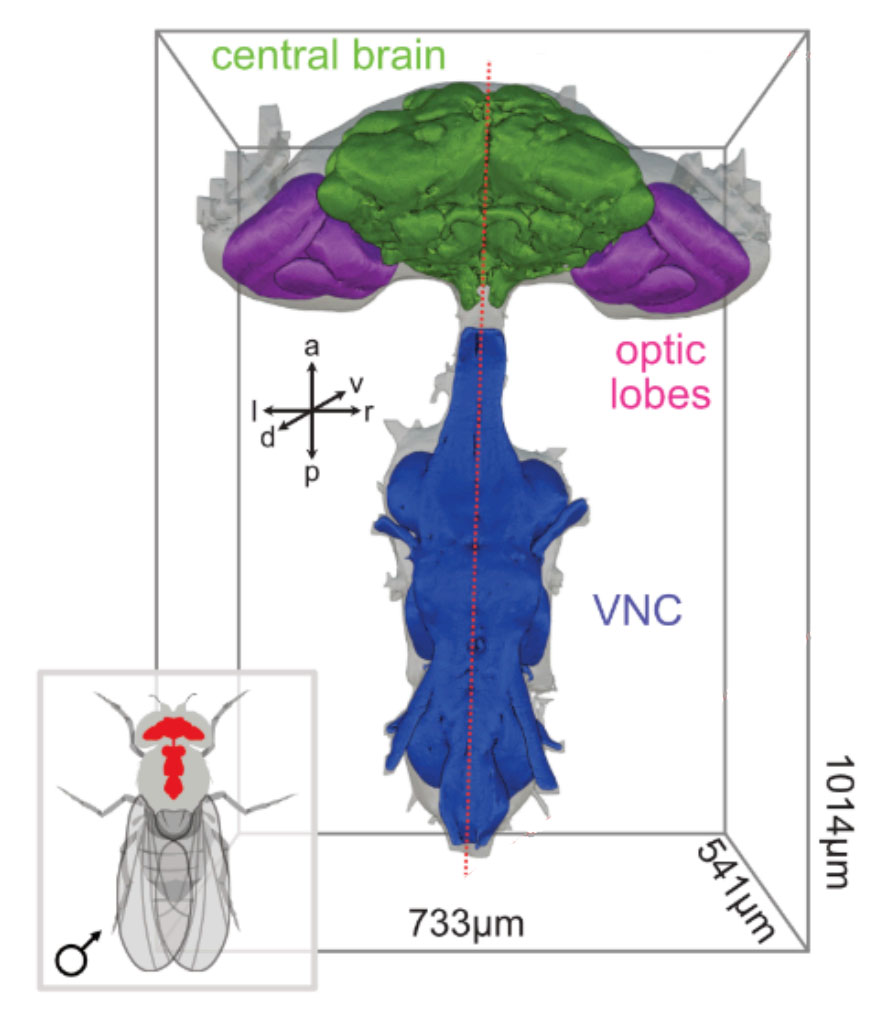
Mapping
Reconstructing and annotating the nervous system from microscopy.
Modelling
Combining wiring with neural dynamics. Shiu and Lappalainen et al. provide relevant modelling precedents.
Continuity
Preserving the evolving simulation state, with verifiable recovery and migration.
A proposed path to persistence
Not lost.
Carried forward.
A computational life needs more than the same code to continue. It needs the state that made this moment possible.
Keep the whole moment.
Commit the neural state, learned changes, random generator state and simulated environment as one compatible checkpoint.
Return to the last known state.
Validate a checkpoint, recover its full state and replay recorded inputs. Account for any gap after the last durable write.
A new machine. A continuing lineage.
Transfer a verified checkpoint to a compatible worker. Keep one active writer per lineage and identify branches explicitly.
Architecture illustration. This is a walkthrough of the proposal, not a running brain simulation.
The research dossier
01The thesisWhat digital continuity means
SYNAFLY investigates persistence for connectome-derived fruit fly simulations: retaining a model’s evolving state across interruptions and machine changes.
The engineering objective is a continuing computational trajectory with a traceable lineage. This does not establish biological immortality, consciousness, or the persistence of a subjective identity.
The project publishes this proposal as a research direction. A full persistence engine and experimental results are not yet available.
02Scientific foundationsFrom anatomical map to computational model
The MaleCNS connectome is the original scientific resource. The Cell paper reports 166,691 neurons across the brain and nerve cord. Janelia records the v1.0 dataset release on 8 June 2026 and publication on 3 September 2026.
Google Research’s account identifies HHMI Janelia as project lead. The official dataset page credits Janelia FlyEM, Cambridge / MRC LMB and Google Research. The dataset is released under CC BY.
Connectivity is a structural constraint; model dynamics require further assumptions. Shiu et al. (2024) studied sensorimotor processing with a computational fly brain model. Lappalainen et al. (2024) combined connectome constraints and task optimization in visual-system models. These are methodological precedents, not evidence of digital immortality.
A filtered simulation graph and an anatomical dataset can have different neuron and connection counts. Their numbers must not be presented as interchangeable.
03The state we must preserveDefine what a checkpoint contains
A complete checkpoint should identify its graph, model version, parameter set, numeric format and runtime. It should include membrane potentials, refractory counters, learned gains, relevant learning traces, random generator state, the simulation clock and controlled environment state.
State must first pass continuously between simulation windows. Periodic saving cannot restore information that the simulation itself discards at a window boundary.
A useful checkpoint must preserve the full model state at a well-defined step boundary. Recovery should be tested against an uninterrupted run using the same inputs and runtime.
04Recovery & migrationMake continuation inspectable
Write checkpoints atomically with integrity checks and maintain independent backup copies. Record the input history needed for replay, and distinguish committed state from work that may be lost in a crash.
A compatible worker should restore the same checkpoint schema before continuing. One active writer prevents contradictory histories. A deliberate fork receives a new lineage identifier linked to its parent checkpoint.
Hash checks establish file integrity, not consciousness or biological equivalence. Restoring the latest checkpoint may omit uncommitted experience; the record must disclose that gap.
05The first experimentA falsifiable continuation test
Run a fixed input sequence in a controlled environment. Preserve a checkpoint, interrupt one worker, restore it and compare its continuation against an uninterrupted reference run.
Measure restored-state agreement, retention of learned changes, the subsequent state trajectory and recovery on a second compatible host. Publish the inputs, runtime, checkpoint schema and comparison procedure.
Cross-platform tests require declared numeric tolerances. A changing live website is not an adequate deterministic test environment. All four tests remain planned; no pass rate or runtime record is claimed here.
06Status & open questionsWhat remains to be built
Available today: this research proposal, the linked original science, public data resources and the interactive neural model. Next: a reproducible local checkpoint-and-recovery prototype.
Open questions include state completeness, numerical stability, graph compatibility, recovery gaps, storage cost and how to define a computational lineage when a state is copied.
SYNAFLY is independent of the cited research institutions. Scientific attribution does not imply affiliation or endorsement.
Built on a public record.
Primary research comes first. Applications are credited at the layer they contribute.
- [01]Berg et al. · Cell · 2026
The complete male Drosophila CNS connectome
- [02]HHMI Janelia · Google Research · Cambridge / MRC LMB
MaleCNS dataset, releases and research credits
- [03]Google Research · 03 Sep 2026
Mapping the complete male fruit fly brain
- [04]Shiu et al. · Nature · 2024
A Drosophila computational brain model reveals sensorimotor processing
- [05]Lappalainen et al. · Nature · 2024
Connectome-constrained networks predict neural activity across the fly visual system